Nursery · Materials · Practical guide
Choosing a Natural Sleep Surface for Your Baby’s Nursery
A baby’s mattress is a small landscape of fibres, layers and seams—but the most important features are not the ones that sound most natural. A suitable crib sleep surface should be firm, flat, correctly sized and used as intended. Material details and certifications can help families understand what they are choosing, while careful attention to fit and care helps keep the sleep space practical.
Published 20 October 2026
Preparing a nursery often begins with a list: cot, sheets, clothing, a place to change and somewhere to sleep. The mattress sits quietly at the centre of that plan. It may be covered by a fitted sheet and rarely seen, yet its construction, condition and fit matter every day.
For families drawn to organic or natural materials, the choices can seem especially dense. Cotton, wool and latex appear alongside phrases such as “chemical-free,” “non-toxic” and “eco-friendly.” Some claims are backed by defined standards; others are broad marketing language. The useful task is to move from appealing labels to verifiable details: What is each layer made from? What does a certification actually cover? Does the mattress fit the cot? How is it meant to be cleaned?
This guide offers a calm way to assess a natural crib sleep surface. It is not a substitute for safe-sleep guidance or a clinician’s advice. For babies, the first priority is a sleep space that follows current public-health recommendations in your part of the UK. Material preferences belong within that framework, not in place of it.
Start with the sleep surface, not the marketing
In a nursery, a mattress has two jobs: provide the intended support and fit its cot securely. For an infant, the surface should be firm, flat and level, with a well-fitting mattress and a tightly fitted sheet. The mattress should be used according to its manufacturer’s instructions and the cot’s instructions.
A mattress described as “plush,” “cushioned” or “comforting” is not automatically suitable for a baby. Nor does a natural filling make a soft or uneven surface appropriate. Avoid adding toppers, quilts, pillows, padded liners or other soft accessories to an infant’s sleep space unless current local guidance specifically says otherwise. Extra layers can change the surface and may create hazards. A fitted sheet designed for the mattress is the practical bedding layer to focus on.
Firmness is not something to judge from a product name. Read the manufacturer’s specifications and check that the mattress is intended for the baby’s cot or crib use. If unsure whether a particular model meets relevant safety requirements, ask the manufacturer or retailer for clear documentation rather than relying on a general “natural” or “organic” claim.
Families in the UK can consult current advice from trusted public-health and safer-sleep organisations, including NHS guidance and The Lullaby Trust. Recommendations can be updated, so check the latest guidance rather than depending on an old checklist or advice passed between households. If a baby has particular medical needs, seek individual guidance from a qualified health professional.
Look beneath the cover
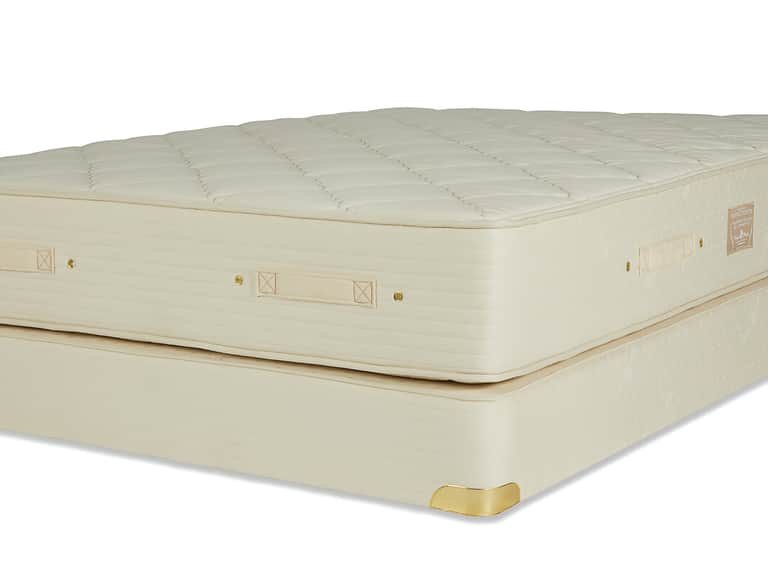
The cover is only one part of a mattress. A natural sleep surface may combine a fabric cover with padding, an inner support layer, barriers, stitching and other components. A description that names organic cotton on the outside does not, by itself, tell you what lies inside.
Ask for a component-by-component description. Is the cover cotton, and is it organic? What is used for the filling or core? Are there bonded layers, adhesives, coatings or membranes? How are the layers held together? Does the maker explain where materials come from and how the mattress is assembled? A trustworthy description should make it possible to understand the product without requiring you to infer its construction from a short slogan.
Organic cotton is used in some mattress covers and fillings. It can feel soft and allow air to pass through the fabric, but its presence does not prove that every mattress component is organic. Wool may appear as padding or as part of a cover, while latex may be used as a resilient core. These materials have different properties and care requirements. “Natural” describes an origin or material category; it does not automatically establish suitability for every baby, a particular safety performance, or a specific environmental impact.
Construction details also clarify what a claim means. A maker might identify the percentage of a material in a component, distinguish a natural latex layer from a synthetic blend, or state whether a textile is certified. When information is vague, ask for the technical sheet, care instructions and certification scope. If answers remain unclear, treat the uncertainty as part of your comparison.
What certifications can—and cannot—tell you
Certifications can make complex supply chains easier to assess, but they are not interchangeable. Their value depends on the standard, the certified organisation or product, and the parts of the mattress covered. A logo on packaging is a starting point for questions, not a complete verdict on a crib mattress.
The Global Organic Textile Standard (GOTS) is associated with organic fibres and textile processing requirements. When a company refers to GOTS, check whether the relevant certificate covers the specific product and components being discussed. Certification of a fabric or facility should not be assumed to certify every layer in a finished mattress. Ask the supplier which certificate applies, who issued it and what its scope includes.
Some certification schemes focus on particular materials or stages of production, while others address restricted substances or emissions. Their names and criteria differ, so compare the actual standard rather than treating all certification marks as equivalent. Where a claim relates to the whole product, look for documentation that clearly identifies the product and the certified scope.
It is also useful to separate three questions that are often blended together in advertising:
- Material origin: What fibres or other materials are used, and how are they described?
- Processing and substances: What does a named standard assess, and which manufacturing stages does it cover?
- Product suitability: Is the mattress designed for the intended cot and infant use, and does it meet applicable safety requirements?
A certification may help answer one of these questions without answering the others. Organic status alone does not establish that a mattress is firm enough, fits a particular cot or is free of every substance a family may wish to avoid. Equally, a product’s safety compliance does not necessarily mean that all of its materials are organic. Reading the scope carefully helps keep these different considerations in view.
Fit is measurable—and worth checking twice
A mattress and cot are designed to work together. Before buying, confirm the internal dimensions specified for the cot and compare them with the mattress dimensions given by its manufacturer. Do not assume that labels such as “standard cot” or “crib size” guarantee a universal fit. Dimensions and product designs can vary.
Once the mattress is in place, check the fit in accordance with the cot manufacturer’s instructions. It should sit evenly and securely, without an unintended gap around the edges. The surface should remain level, and the mattress should not buckle or be forced into the frame. If the cot and mattress are sold separately, keep both sets of instructions and ask the manufacturers to confirm compatibility if anything is uncertain.
Thickness also matters for compatibility. A mattress that is too deep may affect how the cot is intended to function, including the relationship between the sleeping surface and the cot sides. Follow the manufacturer’s guidance on mattress dimensions and the cot’s permitted mattress depth. Avoid improvising with rolled fabric, additional padding or other materials to fill a gap.
For a used cot or mattress, inspect condition as well as size. Look for tears, exposed filling, damaged seams, compressed areas, moisture damage and signs that the mattress has lost its even shape. Check that the model has not been recalled and that instructions and safety information are available. If you cannot establish its history or whether it remains in sound condition, choosing a new, compatible mattress may be the clearer option.
Care instructions are part of the decision
In a nursery, care is not an afterthought. Spills, milk, perspiration and everyday handling all make maintenance relevant. Before choosing a mattress, find out whether the cover is removable, whether any part is washable and how the manufacturer says to clean it. “Easy care” is not specific enough to guide a safe cleaning routine.
Some mattress covers can be removed and washed; others are not designed to come off. Some cores must never be immersed or machine-washed. Follow the product instructions rather than assuming that a natural fibre can be laundered in a particular way. Incorrect washing can cause shrinkage, damage stitching, alter a fit or compromise the product’s construction.
Ask how the mattress should be dried and whether any cleaning products should be avoided. If a waterproof protector is being considered, make sure it is intended for the mattress and does not make the sleep surface uneven or compromise the fit of the sheet. Keep the baby’s sleep setup simple and follow relevant safe-sleep advice about bedding and accessories.
A mattress that cannot be washed may still be maintained as intended, but its care plan should be clear before purchase. Think about who will handle cleaning, what the instructions require and whether the routine is realistic. A straightforward care label can be more useful than a long list of lifestyle claims.
Odour, airing and cautious claims
New products can carry a faint smell from packaging, fabric or manufacturing. Odour alone cannot identify a substance or determine whether a product is safe. Likewise, the absence of a smell is not proof that a product contains no chemicals. Treat “no odour” and “chemical-free” as claims that need context, not as substitutes for construction information or applicable safety documentation.
Follow the manufacturer’s instructions for unpacking and airing a new mattress. If the product has a strong or persistent odour, or you have questions about a specific material, contact the maker and request a clear explanation. Do not use a mattress if it is damaged, damp or visibly contaminated. For health concerns, consult an appropriate health professional rather than trying to diagnose a material exposure from smell alone.
Natural materials can be part of a considered purchasing decision, but “natural” does not mean risk-free for every household. People can have sensitivities to many different materials, natural or manufactured. If a baby has a known allergy or medical condition, discuss material choices with a clinician who understands the child’s needs.
A practical way to compare nursery options
Product pages often present a dense mix of specifications, certifications and benefits. A simple comparison makes it easier to separate what is documented from what is implied. Use the same questions for every mattress you consider, and save the answers alongside the product instructions.
- Confirm intended use. Is the mattress explicitly intended for an infant cot or crib, rather than for an older child, adult bed or general-purpose topper?
- Check cot compatibility. Compare the exact dimensions and permitted thickness with the cot manufacturer’s requirements.
- Assess the surface. Review the product information for a firm, flat sleeping surface and follow current safer-sleep guidance.
- Map the materials. Identify the cover, filling, core and any coatings or bonded layers. Note what remains unspecified.
- Verify certifications. Ask which product and components are covered, and request current documentation where necessary.
- Read care instructions. Find out what can be cleaned, how it should be dried and what actions might damage it.
- Review the practical terms. Check the warranty, returns policy, delivery details and what to do if the mattress arrives damaged or does not fit.
This approach does not require specialist knowledge. It simply gives each claim a place: fit, safety, materials, certification, care or service. If a manufacturer cannot answer a basic question about a component or intended use, that is useful information for your decision.
Common assumptions to set aside
“Organic means safer in every way.” Organic status concerns how particular materials are produced and certified. It does not answer every question about product design, fit, infant suitability or overall safety.
“A natural filling is always breathable enough.” Breathability depends on the finished construction and how the mattress is used. A material name alone cannot describe the performance of the whole product.
“A waterproof layer is necessary for every family.” Needs differ, and product designs vary. If considering a protector, verify compatibility and follow the cot, mattress and safe-sleep instructions. Avoid adding layers that alter the intended surface.
“A good mattress should feel soft to an adult.” Adult comfort impressions are not a reliable way to assess an infant sleep surface. Follow the maker’s specifications and current safer-sleep guidance.
“A certificate on one fabric covers the whole mattress.” Certification scope matters. Check whether it relates to a material, facility, process or finished product, and do not assume it extends beyond what the documentation states.
A quieter kind of nursery preparation
There is a particular stillness to a nursery before it is used: the cot made up, the room’s small details in place, the day’s light moving across the floor. Choosing a mattress can feel like a technical interruption to that scene. Yet the practical questions—dimensions, materials, care, documentation—are part of preparing a dependable space.
For families seeking an organic crib mattress or a natural crib sleep surface, the most grounded choice is not necessarily the one with the longest list of green-sounding words. It is the option whose intended use is clear, whose fit can be confirmed, whose layers are described honestly and whose care instructions make sense for the household. Certifications can add useful evidence when their scope is transparent. They cannot replace attention to the mattress itself.
Begin with a firm, flat, correctly fitted surface used as directed. Keep the sleep space consistent with current safer-sleep advice. Then compare materials and standards with patience, asking for clarification whenever a claim is vague. A clear, well-documented choice may not be the most dramatic feature of the nursery, but it can bring something valuable: confidence grounded in details rather than promises.
Quick checklist for families
- The mattress is intended for infant use in the specific cot or crib.
- Its dimensions and thickness match the cot manufacturer’s requirements.
- The sleep surface is firm, flat and level, and the mattress fits securely.
- The maker identifies the cover, filling, core and other relevant components.
- Certification claims are accompanied by clear information about their scope.
- Care instructions are available and practical for the household.
- The cot is used with a tightly fitted sheet and without unauthorised extra layers or soft accessories.
- Current UK safer-sleep guidance is checked, and individual medical questions are directed to a qualified professional.
This article provides general information, not medical advice. Always follow current safer-sleep guidance, the cot and mattress manufacturers’ instructions, and advice from a qualified health professional where a baby has individual health needs.